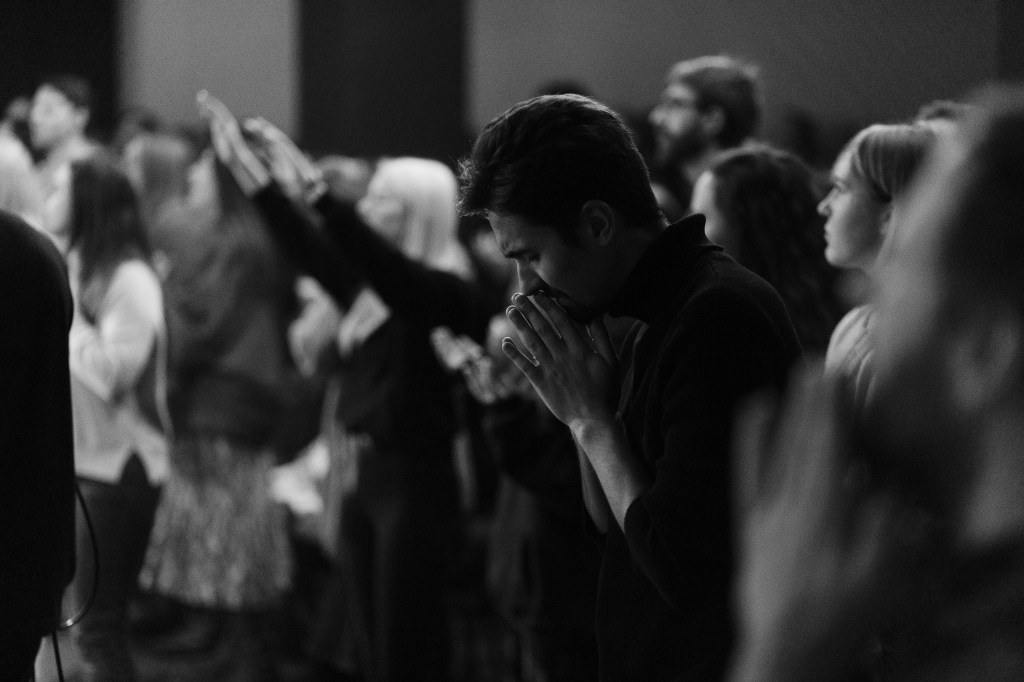
I grew up in a church that others deemed “too much”.
It was a church where people got excited, danced, cried, and knelt. It was a church where people ran around the pews, and where it seemed like the “Spirit” was active as evidenced by the outward manifestations among the church’s congregants.
However, as I matured, I realized my church could also stray from the proper order of worship that the Apostle Paul talks about in 1 Corinthians 14. Biblical literacy tended to be shallow, self-control minimal, and ‘experience’ often seemed more elevated above what the Word of God proclaimed.
When I left home, I went to Bible college, and became hungry for a deeper understanding and knowledge of scripture and proper exegesis. My college was very different than my upbringing, and it became a breath of fresh air as I got to grow deeper in my knowledge of God, and recognize the power of His Word.
But as time went on, I became very suspicious of emotion. I had come to associate emotions with the dangers of relying on them for your understanding of God, and for their connection to believing “ear-tickling” false prophets described in Timothy 4:3 like I had experienced before,
“For the time will come when they will not tolerate sound doctrine; but wanting to have their ears tickled, they will accumulate for themselves teachers in accordance with their own desires,“
Because of this, I wanted nothing to do with emotion.
There was a time when I began to see emotive actions in praise and petition as insincere and, at worst, melodramatic.
But on this journey of faith and living a life of worship, the Lord has continued to grow me in my knowledge and love of Himself and His word, and humble me considerably.
Through reading the Psalms, God has revealed where emotions have their proper place, not only in worship but also in life.
He is expanding my understanding of a healthy and proper approach to knowing God, loving God, and how that is manifested when those two aspects overflow into physical and vocal expression.
God Wants Your Emotions
Our feelings should not be divorced from our worship, nor our faith.
I’m seeing a greater trend in the church where feelings have no place in the life of the believer, and where an intellectually based faith reigns supreme.
While we shouldn’t trust our feelings to guide us, nor should we rely on our feelings to praise Him, God wants us to bring our emotions to Him.
Both the good and the bad.
However, another trend I see is a ‘feelings-based faith’ that tends to derive its truth from the experiential and the sensational. This can create a susceptibility to false doctrine, an inconsistency in Christ likeness, and a devaluation of God’s word.
I know these trends exist because I was a part of both.
Both extremes stray from God’s design for proper worship and living a life of faith.
Our feelings should not dictate whether God is deserving of our worship.
He is worthy of worship regardless of our circumstances or emotions, and His word is our ultimate authority and source of truth.
Nevertheless, the Psalms are full of David and other writers praising God WITH their emotions, and vulnerably seeking Him in every situation.
I am worn out from my groaning.
All night long I flood my bed with weeping
and drench my couch with tears.
7 My eyes grow weak with sorrow;
they fail because of all my foes.8 Away from me, all you who do evil,
for the Lord has heard my weeping.
9 The Lord has heard my cry for mercy;
the Lord accepts my prayer.
10 All my enemies will be overwhelmed with shame and anguish;
they will turn back and suddenly be put to shame.Psalm 6: 6-10
Let Israel rejoice in their Maker;
let the people of Zion be glad in their King.
3 Let them praise his name with dancing
and make music to him with timbrel and harp.
4 For the Lord takes delight in his people;
he crowns the humble with victory.
5 Let his faithful people rejoice in this honor
and sing for joy on their beds.Psalm 149:2-5
The psalmists brought their deepest emotions, alongside their utterances of deepest devotion.
They praised and sought God with gladness, by crying out in sorrow, and oftentimes as tears ran down their desperate faces.
Affectionate and Biblical Worship
In John 4, Jesus reveals to the Samaritan woman God’s design for proper worship and teaches her that our worship should be rooted in Spirit and in Truth. True worship comes from the depths of the heart and soul (Spirit), while also being grounded by a correct understanding of God and His Word (Truth).
Our worship should be scripturally sound, sincere, and empowered by the Holy Spirit.
21 “Woman,” Jesus replied, “believe me, a time is coming when you will worship the Father neither on this mountain nor in Jerusalem. 22 You Samaritans worship what you do not know; we worship what we do know, for salvation is from the Jews. 23 Yet a time is coming and has now come when the true worshipers will worship the Father in the Spirit and in truth, for they are the kind of worshipers the Father seeks. 24 God is spirit, and his worshipers must worship in the Spirit and in truth.”
John 4:21-24
God doesn’t want our theology and faith to be cerebral only. He wants it to be heartfelt, honoring, and raw.

Don’t make the same mistake I did.
Don’t judge the woman who is singing and kneeling down with tears.
Don’t judge that man who is jumping up and down with arms raised high during that upbeat praise song.
You don’t know what they went through this week, and what trial or situation Christ has brought them from. Maybe she is grappling with a profound loss, while he is rejoicing in praise for a prodigal son who has returned home. Quite possibly, they are even overcome in reverence.
They might look too “charismatic” for some, or too “fanatical” to others.
But perhaps Jesus is meeting them there, and revealing Himself as he touches both the head and the heart.
If the modern church seems too “emotional” for you, I urge you to look at David in the Psalms and in 2 Samuel 6:14-22, or the sinful woman in Luke 7.
They weren’t scared of looking like a fool or afraid of vulnerability.
They weren’t ashamed of how desperately they needed God, and what that desperation might have looked like to the world.
The sinful woman was not ashamed as she knelt down at Jesus’ feet, washing them with her tears, and drying them with her hair. She was forgiven much, so she loved much.
She blessed Him not only by the pouring of the costly oil from her Alabaster Jar, but by the poured-out devotion of her heart.
37 And behold, a woman in the city who was a sinner, when she knew that Jesus sat at the table in the Pharisee’s house, brought an alabaster flask of fragrant oil, 38 and stood at His feet behind Him weeping; and she began to wash His feet with her tears, and wiped them with the hair of her head; and she kissed His feet and anointed them with the fragrant oil.
Luke 7: 37-38
Is your faith solely enclosed within the bounds of intellectuality, or is it also touching the heart?
After all, it was David who penned these emotional words:
Psalm 31
I will be glad and rejoice in your love,
for you saw my affliction
and knew the anguish of my soul.
8 You have not given me into the hands of the enemy
but have set my feet in a spacious place.9 Be merciful to me, Lord, for I am in distress;
my eyes grow weak with sorrow,
my soul and body with grief.
10 My life is consumed by anguish
and my years by groaning;
my strength fails because of my affliction,[b]
and my bones grow weak…”“21 Praise be to the Lord,
for he showed me the wonders of his love
when I was in a city under siege.
22 In my alarm I said,
“I am cut off from your sight!”
Yet you heard my cry for mercy
when I called to you for help.23 Love the Lord, all his faithful people!
The Lord preserves those who are true to him,
but the proud he pays back in full.
24 Be strong and take heart,
all you who hope in the Lord.”
Your worship may look different than this, and you may not bring tears or dance. That’s okay.
But may your life of worship always be unashamed, sincere, Spirit-filled, and rooted in God’s truth!
 Cultivate a Lifestyle of Worship + Love of the Word
Leave a comment